Wait! Don’t Go Yet! 👋
We see you eyeing those adorable outfits! 😍 Before you leave, here’s 10% OFF your first order!
Hurry, your little one’s next favorite outfit is waiting! 🛍️✨
We see you eyeing those adorable outfits! 😍 Before you leave, here’s 10% OFF your first order!
Hurry, your little one’s next favorite outfit is waiting! 🛍️✨
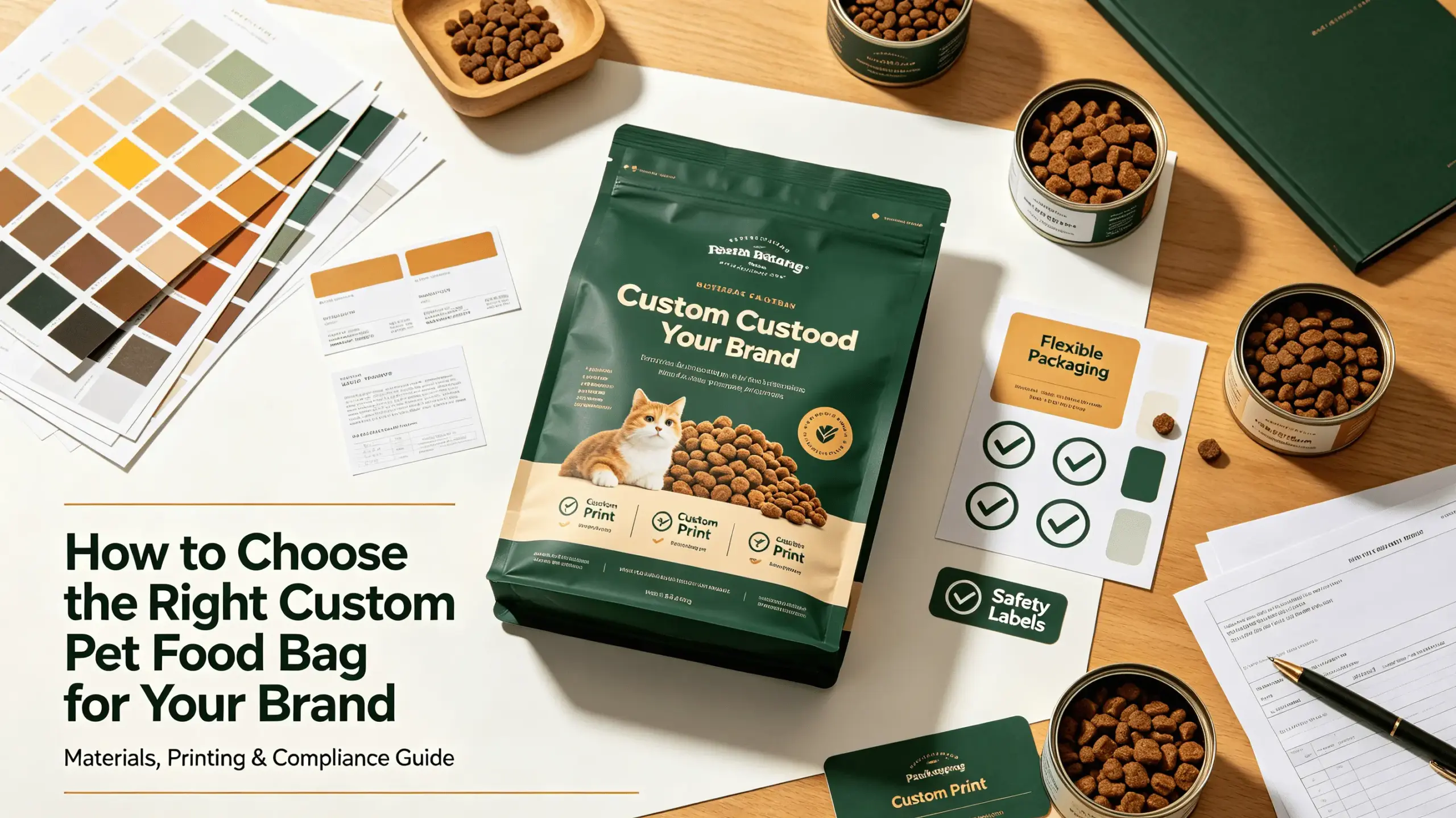
For pet food brands targeting global markets — especially Europe and the US — packaging is far more than a protective shell. It’s your first salesperson on the shelf, your brand’s silent ambassador, and a critical compliance document all in one.
But with dozens of bag styles, material combinations, printing processes, and certification requirements to navigate, choosing the right custom pet food bag can feel overwhelming. This guide breaks it all down — from bag structure and barrier materials to printing processes and supplier checklists — so you can make confident, informed decisions that support your brand’s growth.
Before choosing any bag, start with what’s inside. Different pet food formulas have very different packaging requirements:
| Pet Food Type | Key Packaging Challenge |
|---|---|
| Dry Kibble | Moisture & oxygen barrier, large fill weight |
| Wet / Semi-Moist | High barrier, leak-proof sealing |
| Freeze-Dried & Raw | Maximum oxygen barrier, light protection |
| Treats & Snacks | Resealability, shelf appeal, portion control |
Getting this right at the start saves you from costly material mismatches down the line.
Bag structure directly affects shelf presence, consumer convenience, and production efficiency. Here are the four most common styles for pet food:
The most popular format for dry kibble and treats. Stands upright on shelves for maximum visibility, typically paired with a resealable zipper. Available in a wide range of sizes from 100g trial packs to 15kg bulk bags.
A premium upgrade from the standard stand-up pouch. Features a flat base that gives the bag a “box-like” structure — excellent for high-end and organic pet food brands that want a distinctive shelf presence.
Ideal for large-volume dry kibble (5kg–20kg). The side gussets expand to accommodate high fill weights while maintaining a clean, professional appearance. Widely used by mid-to-large pet food manufacturers.
A flat, sealed-on-three-sides format commonly used for single-serve portions, sample packs, and treats. Simple to produce, cost-effective for small SKUs.
| Product | Recommended Style |
|---|---|
| Daily dry kibble (1–5kg) | Stand-Up Pouch |
| Premium / organic food | Flat Bottom Bag |
| Bulk kibble (5kg+) | Side Gusset Bag |
| Treats / trial packs | Three-Side Seal Bag |
Material selection is where food safety, shelf life, and sustainability intersect. For custom pet food bags, the most common film structures are:
| Structure | Properties | Best For |
|---|---|---|
| PET / AL / PE | High oxygen & moisture barrier, puncture resistant | Wet food, freeze-dried, raw |
| BOPP / PE | Good clarity, cost-effective | Dry treats, light snacks |
| Kraft / PE | Natural look, moderate barrier | Premium dry kibble, eco-positioning |
| PET / PE | Transparent, recyclable-friendly | Treats with window display |
| Matte OPP / AL / PE | Premium matte finish, strong barrier | High-end dry food, freeze-dried |
Sustainability is no longer optional for brands entering European markets. Look for:
✅ At HICWE, we offer BRC-certified flexible packaging materials for custom pet food bags, helping your brand meet EU sustainability requirements without compromising barrier performance.
The right functional features improve consumer experience and directly impact repurchase rates. Here’s what to consider:
Essential for dry kibble and treats. Keeps food fresh after opening and is one of the top features pet owners look for. Options include press-to-close zippers, slider zippers, and child-resistant closures.
Critical for freshly roasted or processed pet food that continues to off-gas after packaging. A one-way valve releases internal gas without allowing oxygen in — preventing bag bloating and extending shelf life.
A small but important detail. A well-placed tear notch makes opening easy and clean — especially important for large bags where consumers may struggle with scissors.
A transparent window lets consumers see the product inside, building trust and increasing perceived quality. Particularly effective for premium kibble, freeze-dried chunks, and colorful treats.
Useful for retail display on pegboards. Simple addition that significantly expands your retail placement options.
In the highly competitive pet food market, printing quality is often the deciding factor between a product that gets picked up and one that gets passed over. This section draws on the same principles used by leading European pet food brands to optimize their packaging print strategy.
| Process | Best For | Key Advantage |
|---|---|---|
| Gravure Printing | Large batches (100,000+ units/month) | Highest color accuracy, finest detail |
| Flexographic Printing | Medium batches (10,000–100,000 units) | Fast turnaround, eco-friendly inks |
| Digital Printing | Small batches, limited editions, samples | No plate cost, maximum customization |
For most growing pet food brands, flexographic printing offers the best balance of quality, speed, and cost. As your volumes scale, transitioning to gravure printing delivers superior color consistency and long-term cost efficiency.
The finish you choose communicates your brand positioning before a consumer reads a single word:
For brands in the premium and super-premium segment, hot stamping (gold or silver foil on logos) and embossing/debossing (raised or recessed textures) add a tactile dimension that photography cannot replicate. A European mid-range natural kibble brand that added partial gold hot stamping and UV varnishing to its packaging saw shelf recognition increase by 40% and sales grow 25% within three months.
Ensure your printing inks comply with:
Getting the bag dimensions right prevents wasted material, poor fill ratios, and consumer dissatisfaction. Here are standard reference sizes for common pet food categories:
| Product | Fill Weight | Recommended Bag Size (W × H, approx.) |
|---|---|---|
| Cat dry food | 500g | 160 × 250mm |
| Cat dry food | 1.5kg | 220 × 330mm |
| Dog dry food | 2kg | 240 × 360mm |
| Dog dry food | 5kg | 300 × 450mm |
| Dog dry food | 10kg | 380 × 560mm |
| Treats / snacks | 100–200g | 130 × 200mm |
| Freeze-dried | 200–500g | 160 × 260mm |
Note: These are reference dimensions. Final sizing depends on your product’s bulk density, filling method (manual vs. automatic), and gusset depth. Always confirm with your packaging supplier before finalizing artwork.
Compliance is non-negotiable for pet food brands entering regulated markets. Here’s what to verify with your packaging supplier:
If your brand uses licensed characters or imagery (e.g., Disney-licensed designs), your packaging supplier must hold the appropriate print licensing. Non-compliant use of licensed IP can result in product recalls and legal liability.
✅ HICWE is a Disney Licensed Supplier and holds BRC certification, ensuring your custom pet food packaging meets both creative and compliance requirements.
Understanding production logistics helps you plan inventory and cash flow effectively.
Never skip the sampling stage. A physical sample lets you verify:
Requesting a free sample before bulk order is standard practice with reputable suppliers — and a red flag if a supplier refuses.
| Stage | Typical Timeline |
|---|---|
| Sample production | 7–14 business days |
| Sample approval & revision | 3–7 business days |
| Mass production | 15–25 business days |
| Shipping (sea freight to EU/US) | 25–35 days |
Plan your packaging procurement 8–12 weeks ahead of your target launch date to avoid delays.
Before committing to a supplier for your custom pet food bags, use this checklist:
— Non-negotiable for FDA, EU, and LFGB compliance.
— Align process with your volume and budget.
— Protects you from costly surprises at scale.
— Look for first-piece inspection, in-process sampling, and final QC reports.
— Market-specific experience means fewer compliance blind spots.
Choosing the right custom pet food bag isn’t a single decision — it’s a series of aligned choices across bag style, material structure, functional features, printing process, and compliance requirements. Get these right, and your packaging becomes a genuine competitive advantage: driving shelf recognition, building consumer trust, and supporting long-term brand growth.
Whether you’re launching a new pet food line, scaling an existing brand, or entering European and US markets for the first time, the right packaging partner makes all the difference.
Ready to get started? Explore our full range of custom pet food packaging solutions — or contact us today to request a free sample and get a custom quote tailored to your product and market.
For B2B pet food brands expanding into international markets — especially Europe and the United States — customs clearance is one of the most critical
From your first inquiry to finished bags at your warehouse — our streamlined 4-step process gets your custom packaging produced and delivered with zero guesswork.
Tell us your product type, bag style, target size, order quantity, destination market, and any special functional needs.
Review the pouch format, material structure, barrier level, printing and functional features.
Submit your artwork for pre-press review. A physical sample is produced for your sign-off before any bulk production begins.
Bags are produced under 4-stage QC, packed in export cartons, and shipped to your door with full documentation included.
Fill in your project details below — our packaging specialists will respond within 24 hours with a tailored recommendation and indicative pricing.
Fill in your project details below — our packaging specialists will respond within 24 hours with a tailored recommendation and indicative pricing.