
Wait! Don’t Go Yet! 👋
We see you eyeing those adorable outfits! 😍 Before you leave, here’s 10% OFF your first order!
Hurry, your little one’s next favorite outfit is waiting! 🛍️✨
We see you eyeing those adorable outfits! 😍 Before you leave, here’s 10% OFF your first order!
Hurry, your little one’s next favorite outfit is waiting! 🛍️✨
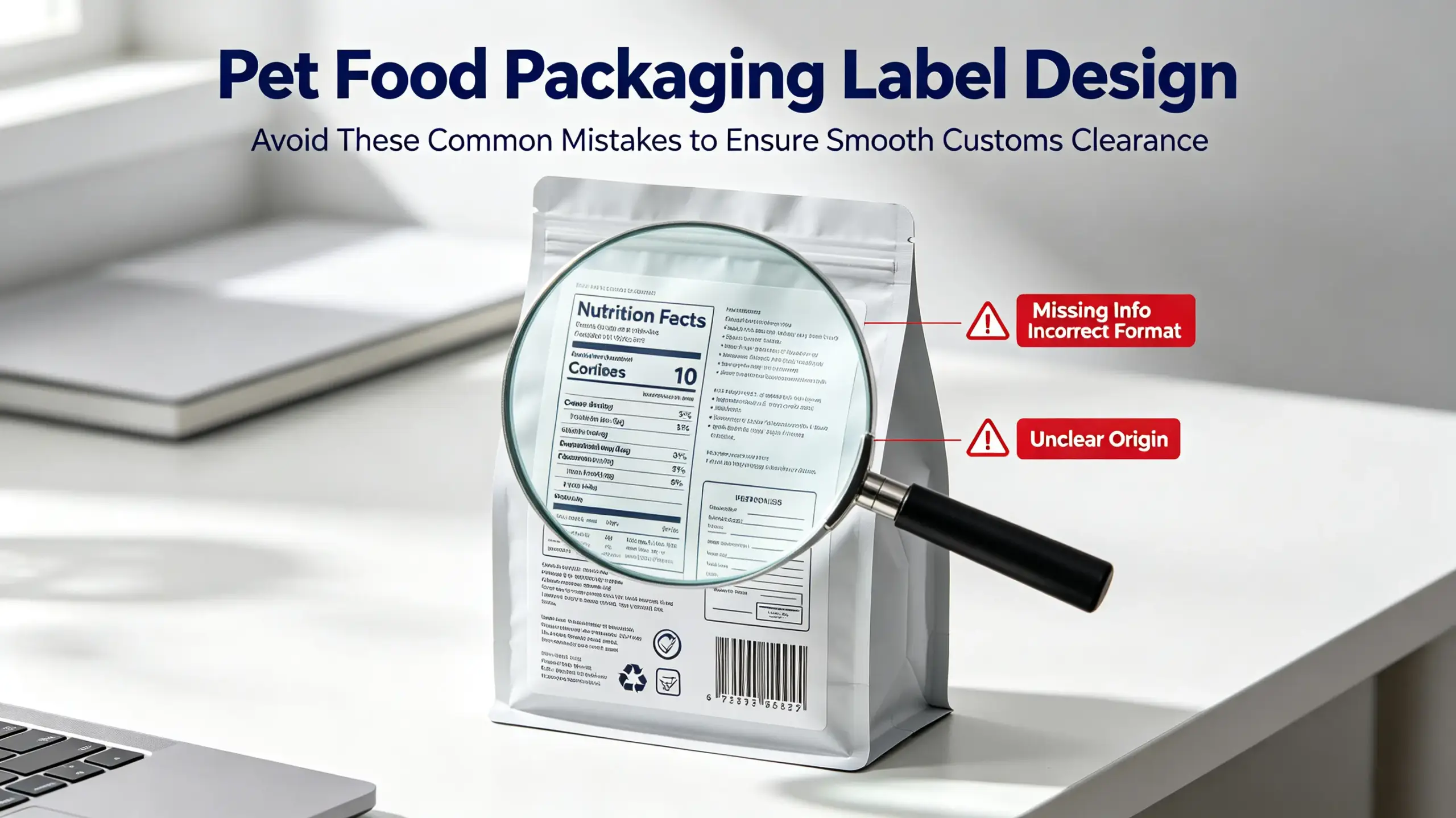
For B2B pet food brands expanding into international markets — especially Europe and the United States — customs clearance is one of the most critical and risk-prone steps in the entire supply chain. Yet time and again, brands arrive at this stage underprepared, only to discover that their packaging labels contain errors that trigger inspections, delays, fines, or outright shipment rejection.
The frustrating reality? Most of these failures are entirely preventable.
Your packaging label is not just a design element — it is the primary document through which customs authorities assess whether your product is legal, safe, and fit for sale in their market. Get it right, and your shipment clears smoothly. Get it wrong, and the consequences can set your market entry back by months.
This guide breaks down the five most common pet food packaging label mistakes that cause customs clearance failures, explains why they happen, and provides practical strategies to avoid them — so your products can reach international shelves without unnecessary delays.
Pet food occupies a unique regulatory position. Unlike general consumer goods, it sits at the intersection of animal health, food safety, and environmental regulation — which means the authorities scrutinizing your labels are thorough, and the standards are strict.
Here’s why label compliance directly determines your customs clearance outcome:
Major international markets have codified mandatory labeling standards for pet food. The EU’s Regulation (EC) No 183/2005, for example, specifies exactly what information must appear on every pet food package sold within the bloc — including product name, full ingredient list, net weight, production date, shelf life, manufacturer details, and country of origin. Non-compliant labels are grounds for immediate rejection at customs, regardless of product quality.
Border authorities cannot inspect every unit in a shipment. Your label is their primary tool for assessing whether your product complies with local safety and regulatory standards. Incomplete, inaccurate, or misleading label information triggers targeted inspections, extends clearance timelines, and in serious cases results in product detention or destruction.
A customs detention doesn’t just cost you the direct losses — transportation fees, storage charges, re-labeling costs. It delays delivery to your local distributors, damages those relationships, and creates a compliance record that can make future shipments subject to heightened scrutiny. The reputational cost in a new market can far outlast the financial one.
This is the single most frequent cause of pet food customs clearance failures — and the most avoidable.
Many brands make the mistake of adapting their domestic labels for international markets without thoroughly researching what the destination market actually requires. The result is labels that look complete but are missing critical regulatory content.
The most commonly missing elements include:
Incomplete ingredient list or nutritional information: The EU and US both require all ingredients to be listed in descending order of weight, accompanied by a detailed nutritional composition table (crude protein, crude fat, crude fiber, moisture content). Partial ingredient lists or missing nutritional panels are among the top reasons for customs rejection.
Vague or absent country of origin: Most markets require a clear, prominent declaration of origin — “Made in China,” for example. Ambiguous statements such as “Processed with Imported Ingredients” do not satisfy this requirement and will be flagged as non-compliant.
Incomplete manufacturer or importer information: The full legal name, address, and contact details of the manufacturer or responsible importer must appear on the label. Abbreviations, trade names without legal entity details, or incorrect addresses give customs no way to verify the product’s source — and that’s a red flag.
Language requirements are frequently underestimated by brands entering non-English-speaking markets — and the consequences are severe.
Common language-related failures:
Wrong language for the destination market: The EU requires that labels include the official language(s) of the importing country. Selling into Germany requires German. Selling into France requires French. An English-only label — regardless of how well-designed it is — will be rejected at customs in these markets. Canada requires both English and French on all consumer product labels.
Machine-translated labels: Relying on automated translation tools for regulatory label content is a significant compliance risk. Machine translation frequently mistranslates technical terminology — for example, confusing “feed additive” with “food additive” — or produces ambiguous phrasing that customs authorities flag as potentially misleading. Professional human translation, verified by a local regulatory expert or distributor, is not optional — it’s essential.
Certification marks — organic, BRC, FDA-compliant, and others — carry significant weight with both consumers and customs authorities. That’s precisely why their misuse is treated seriously.
Two categories of mistakes to avoid:
Using certification marks without authorization: Displaying an organic certification logo, an FDA compliance mark, or an EU-recognized certification symbol without having obtained the corresponding official certification is a form of false labeling. Customs authorities actively check for this, and the penalties — including product seizure and potential bans on future imports — are severe.
Displaying valid certifications incorrectly: Even brands that hold legitimate certifications can run into problems if the mark is displayed with an expired certification number, in a non-standard size or color, or in a position that doesn’t meet official display requirements. Always follow the exact display specifications provided by the certifying body.
✅ HICWE holds BRC (Global Recycled Standard) certification and is a Disney Licensed Supplier — ensuring that certification marks on your custom pet food packaging are legitimate, current, and correctly displayed.
For pet food products with specific attributes — high-fat formulations, functional foods containing additives, products intended for specific life stages — most major markets mandate warning labels. Missing or illegible warnings are a consistent source of customs clearance problems.
Common warning label omissions:
Storage and handling warnings: Products sensitive to temperature or humidity must carry clear storage instructions — “Store in a cool, dry place,” “Keep away from direct sunlight,” and similar. Omitting these on temperature-sensitive formulations (such as raw or freeze-dried food) is a compliance failure.
Life stage and suitability warnings: Functional pet food formulated for adult animals but unsuitable for puppies or kittens must clearly state this. For example: “Not suitable for puppies under 6 months of age.” Failing to include this information on products that contain ingredients or nutrient levels inappropriate for young animals is both a regulatory violation and a genuine safety concern.
Even when all the required information is present and accurate, poor execution in label formatting and print quality can still result in customs rejection.
The most common format and print failures:
Font size below regulatory minimums: EU and US regulations specify minimum font sizes for mandatory label information — typically no smaller than 6pt for ingredient lists and key declarations. Labels where this information is printed too small to read clearly will be flagged as non-compliant, regardless of content accuracy.
Mandatory information placed in vulnerable positions: Printing required information on packaging seams, tear strips, or resealable closures is a common mistake. These areas are subject to damage during shipping and handling — and if the information becomes illegible or detaches, the label fails compliance even if it was technically correct when it left the factory.
Blurred or faded printing: Low-quality printing that results in blurred text, faded colors, or incomplete characters makes label information unreadable. This is especially problematic for ingredient lists and nutritional tables, where precision matters both for compliance and consumer safety.
Label compliance starts long before the design brief is written. Before entering any new international market, conduct a thorough audit of the destination country’s pet food labeling requirements.
Consistency and accuracy in how information is presented are the foundations of label compliance.
Certification marks should never appear on packaging without a formal internal review confirming their legitimacy and correct display.
Don’t treat warning labels as an afterthought. Build them into the label design process from the start, based on a structured assessment of your product’s characteristics.
Compliance on paper means nothing if the printed label doesn’t match the approved design. Build inspection checkpoints into your production and shipping workflow.
Even brands with good intentions fall into these common traps:
“We can adapt our domestic labels for international markets.” This is one of the most expensive assumptions in international pet food trade. Domestic label requirements and international market requirements are fundamentally different — not just in content, but in language, format, and regulatory philosophy. Always build international labels from the destination market’s requirements up, not from your domestic label down.
“Machine translation is good enough for label content.” It isn’t — especially for regulatory text. The technical terminology used in pet food labeling (ingredient classifications, additive declarations, nutritional parameters) requires translators with specific domain expertise. A single mistranslated term can transform a compliant label into a misleading one in the eyes of customs authorities.
“Small shipments don’t need to meet full compliance standards.” Customs authorities do not apply a lower standard to small-volume shipments, samples, or trial orders. Every shipment — regardless of size — is subject to the same label compliance requirements. Non-compliant labels on a sample shipment will be rejected just as firmly as a full container load.
A mid-sized B2B pet food brand specializing in freeze-dried formulations encountered a serious setback when entering the German market for the first time. Their shipment was detained at customs because the product labels were English-only, lacked a German-language ingredient list, and did not include a country of origin declaration in the format required by EU regulations.
The detention delayed delivery to their German distributor by two months, resulting in direct financial losses of €50,000 and significant damage to a newly established distribution relationship.
Rather than treating this as a one-time problem to patch, the brand used it as the catalyst for a comprehensive label compliance overhaul:
The results were significant. The brand’s products cleared German customs without issue on the next shipment. Within six months, orders from their German distributor had grown by 40%. The compliant label framework they built for Germany was then adapted for France and Italy, enabling the brand to expand across the EU without repeating the same costly mistakes.
In an environment of increasingly stringent global pet food regulation, a compliant packaging label is not a nice-to-have — it is the price of admission to international markets. The cost of getting it wrong (detention fees, destroyed goods, damaged distributor relationships, reputational harm) consistently exceeds the cost of getting it right from the start.
The brands that succeed in international pet food markets are those that treat label compliance as a strategic investment, not an administrative burden. By researching destination market requirements thoroughly, standardizing your label design and translation processes, managing certification marks rigorously, and building multi-stage inspection into your production workflow, you can eliminate the most common causes of customs clearance failure before they ever become a problem.
Looking for a packaging partner who understands international compliance requirements as well as manufacturing quality? Explore our custom pet food packaging solutions — or contact us today to discuss how we can help you build packaging that meets the standards of your target markets from day one.
For pet food brands targeting global markets — especially Europe and the US — packaging is far more than a protective shell. It’s your first
From your first inquiry to finished bags at your warehouse — our streamlined 4-step process gets your custom packaging produced and delivered with zero guesswork.
Tell us your product type, bag style, target size, order quantity, destination market, and any special functional needs.
Review the pouch format, material structure, barrier level, printing and functional features.
Submit your artwork for pre-press review. A physical sample is produced for your sign-off before any bulk production begins.
Bags are produced under 4-stage QC, packed in export cartons, and shipped to your door with full documentation included.
Fill in your project details below — our packaging specialists will respond within 24 hours with a tailored recommendation and indicative pricing.
Fill in your project details below — our packaging specialists will respond within 24 hours with a tailored recommendation and indicative pricing.